
Growing mushrooms
Liquid culture vs spore syringe
Jun
Understanding the differences between liquid culture vs spores syringe. While both methods are widely used for cultivatingt mushrooms, but they have distinct differences in their techniques, requirements, and outcomes.
Liquid Culture vs spore syringe: A Comprehensive Comparison
For cultivators, the choice between a spore syringe and a liquid culture (LC) is a crucial first step. Both methods offer a way to introduce mycelium – the vegetative part of a fungus – into a substrate, but they differ significantly in their process, efficiency, and overall ease of use.
This article will delve into the key distinctions between spore syringes and liquid cultures, helping you make an informed decision based on your experience level and goals.
Spore Syringe vs Liquid Culture
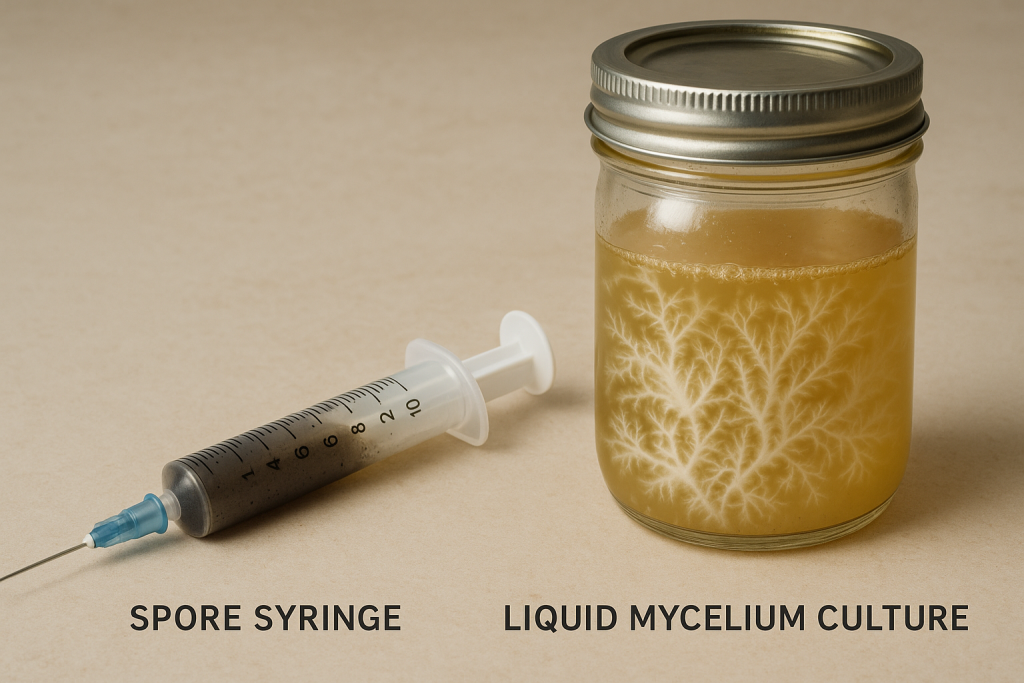
The primary difference lies in the starting material. A spore syringe contains a suspension of fungal spores in sterile water. These spores are the reproductive units of the fungus, and when they land on a suitable substrate under appropriate conditions, they germinate and develop into mycelium.
A liquid culture, on the other hand, already contains actively growing mycelium in a nutrient-rich liquid broth. This pre-grown mycelium is ready to be introduced directly into your substrate, bypassing the germination stage.
| Feature | Spore Syringe | Liquid Culture (LC) |
|---|---|---|
| Starting Material | Fungal spores | Actively growing mycelium in liquid broth |
| Process | Spores germinate, then colonize the substrate | Mycelium directly inoculated into the substrate |
| Contamination Risk | Higher, due to the germination stage | Lower, as mycelium is already established |
| Colonization Time | Longer | Significantly faster |
| Yield Potential | Potentially lower, dependent on successful germination | Potentially higher, due to faster colonization |
| Cost | Generally cheaper | More expensive |
| Skill Level | Beginner-friendly (though requires sterile technique) | Intermediate to advanced (requires sterile technique and experience) |
Spore Syringe:
- Pros:
- Relatively inexpensive.
- Easy to store and transport.
- Widely available for various fungal species.
- Good for beginners wanting to learn the basics of mycology.
- Cons:
- Higher risk of contamination during the germination phase.
- Slower colonization time compared to liquid culture.
- Requires more careful technique to avoid introducing contaminants.
- Germination rates can vary, leading to inconsistent results.
Liquid Culture (LC):
- Pros:
- Faster colonization times, resulting in quicker harvests.
- Lower risk of contamination compared to spore syringes (once the LC is established).
- Potential for higher yields due to the vigorous growth.
- Allows for easier scaling up of production.
- Cons:
- More expensive than spore syringes.
- Requires more advanced techniques and sterile equipment.
- Higher initial investment in equipment and materials.
- Potential for contamination if proper sterile techniques are not followed.
Culture versus Spores: A Summary of LC vs Spores
The core difference between a liquid culture versus spores boils down to the developmental stage of the fungus. Spores represent the beginning, a single unit needing to germinate and grow. Liquid culture represents a much more advanced stage: established, vigorous mycelium ready to colonize a larger substrate. This difference leads to the practical implications outlined above.
Choosing the Right Method:
- Beginners: Spore syringes offer a gentler introduction to the world of cultivation, allowing you to practice sterile technique without the added complexities of LC.
- Experienced Cultivators: Liquid cultures are preferred for their speed, efficiency, and higher potential yields. The lower risk of contamination, once the LC is established, is also a significant advantage for large-scale operations.
Ultimately, the best method depends on your experience, resources, and goals. While spore syringes offer accessibility and affordability, liquid cultures provide a significant advantage in speed and yield for more advanced cultivators. Understanding the nuances of each method will empower you to make the best choice for your fungal cultivation endeavors.
